
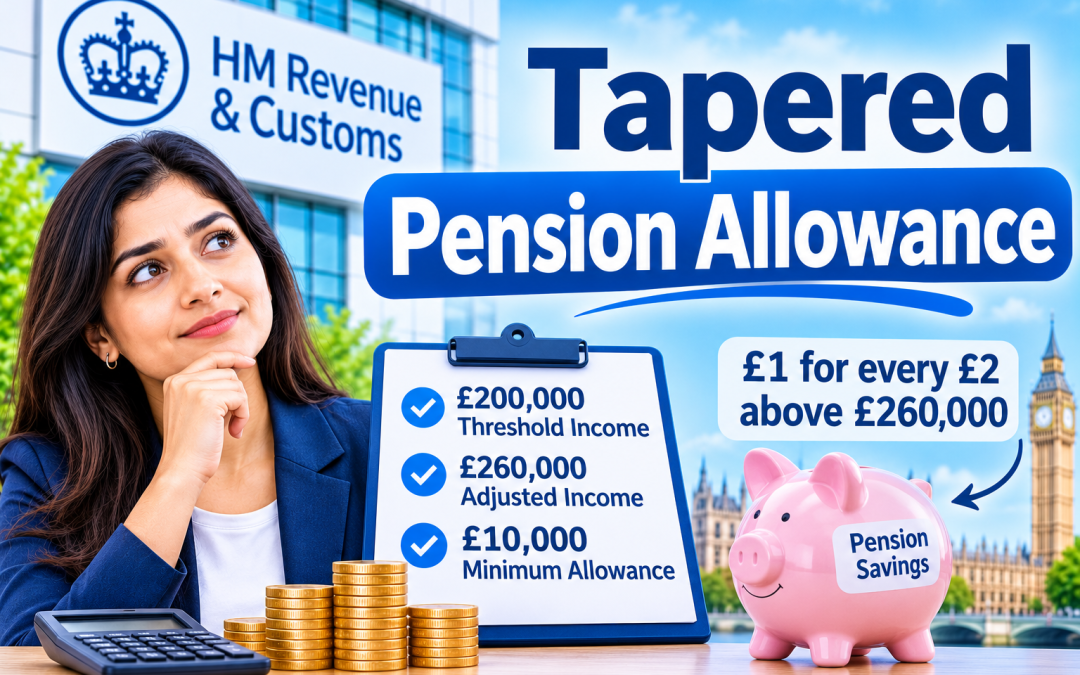
A big bonus lands, your employer tops up your pension as usual, and months later a letter arrives saying you may have gone over your annual allowance. For high earners, the reason is often the tapered pension allowance: a rule that quietly shrinks how much you can save into pensions each year with tax relief. This guide explains who it affects, how to work out your own figure step by step, and what happens if your savings go over it.
- Both tests must be met: threshold income over £200,000 and adjusted income over £260,000.
- Employer pension contributions count towards adjusted income but not threshold income.
- At £360,000 of adjusted income or more, your allowance is the £10,000 minimum.
- Unused allowance from the three previous tax years can often be carried forward to cover an excess.
- Any annual allowance charge must be reported on your Self Assessment return, even if your scheme pays it.
What Is the Tapered Pension Allowance?
The annual allowance is the most you can save into pensions in a tax year with tax relief before a tax charge applies. For most people it’s £60,000, or 100% of their earnings if lower. The tapered pension allowance reduces that limit for people with very high incomes, so the tax relief they get on pension savings is restricted.
| Figure | 2026/27 | What it means |
|---|---|---|
| Standard annual allowance | £60,000 | The normal yearly limit |
| Threshold income test | £200,000 | At or below this, the taper can’t apply |
| Adjusted income test | £260,000 | The taper starts above this |
| Taper rate | £1 for every £2 | Allowance falls by half the excess |
| Adjusted income where the floor is reached | £360,000 | Allowance can’t fall further |
| Minimum tapered allowance | £10,000 | The lowest it can go |
These figures have applied since 2023/24, according to GOV.UK’s guidance on the tapered annual allowance, and they are unchanged for 2026/27. The people most often affected are senior employees with large bonuses, company directors whose companies pay big employer contributions, people with high rental or investment income, and members of defined benefit schemes such as consultants in the NHS.
Why the taper exists
Pension contributions get tax relief at your highest rate, so the very top earners gain the most from them. The tapered pension allowance was introduced in April 2016 to limit that benefit. The thresholds were raised in April 2020 and again in April 2023, which took many people out of it. Today it mainly affects people with total income well into six figures, plus a few others pushed over the line by a one-off bonus or a large employer contribution.
Does the Taper Apply to You? A 3-Question Check
- Is your threshold income over £200,000? If not, stop here. Your allowance isn’t tapered, whatever your adjusted income.
- Is your adjusted income over £260,000? If not, stop here. You keep the full £60,000.
- Are your total pension savings for the year above your tapered allowance? If they are, you may face an annual allowance charge, unless carry forward covers the excess.
The two income tests use different definitions, which is where most mistakes happen. The next section explains them.
Threshold Income and Adjusted Income Explained
Both tests start from your net income: all your taxable income for the year, such as salary, bonus, profits, rent, dividends and savings interest, less certain reliefs. Then each test adjusts it differently. Following the steps on GOV.UK, the main pension adjustments are:
| Type of pension saving | Threshold income | Adjusted income |
|---|---|---|
| Personal contributions with relief at source (most personal and some workplace pensions) | Deduct the gross amount | Already included, because net income isn’t reduced by them |
| Contributions taken from pay before tax (net pay arrangement) | Already excluded, because pay is reduced | Add them back |
| Salary sacrifice set up after 8 July 2015 | Add back the salary given up | Included through the employer contribution |
| Employer contributions | Not included | Add them |
| Defined benefit growth | Not included | Included as part of employer pension savings |
| Lump sum death benefits from a registered scheme | Deduct | Deduct |
They sound alike but are used for different things. Adjusted net income decides the £100,000 Personal Allowance taper and the child benefit charge. Adjusted income is only used for the pension taper and includes employer contributions. See our guide to adjusted net income for the other measure.
How to Work Out Your Tapered Pension Allowance
If you pass both tests, the formula is: £60,000 − (adjusted income − £260,000) ÷ 2, but never less than £10,000. Here’s how it plays out in practice.
A quick worksheet
You can work out your own tapered pension allowance with six lines on a piece of paper:
- Write down your net income: all taxable income for the year.
- Threshold income: line 1, minus gross relief-at-source contributions, plus salary sacrificed after 8 July 2015.
- If line 2 is £200,000 or less, stop. Your allowance is £60,000.
- Adjusted income: line 1, plus pay-before-tax pension contributions and employer contributions (including salary sacrifice amounts).
- If line 4 is £260,000 or less, stop. Your allowance is £60,000.
- Allowance: £60,000 minus half of (line 4 − £260,000), with a minimum of £10,000.
Salary £230,000, bonus £40,000. Personal pension contributions of £20,000 gross with relief at source, and employer contributions of £15,000.
- Net income: £270,000.
- Threshold income: £270,000 − £20,000 = £250,000, so the first test is met.
- Adjusted income: £270,000 + £15,000 = £285,000, so the second test is met.
- Tapered allowance: £60,000 − (£25,000 ÷ 2) = £47,500.
- Total pension savings: £35,000, which is within the allowance, so there’s no charge this year, and the unused £12,500 may be carried forward.
Salary £12,570, dividends £150,000, and the company pays £100,000 into the director’s pension.
- Threshold income: £162,570. That’s under £200,000, so the taper doesn’t apply, even though adjusted income is £262,570.
- The director keeps the full £60,000 allowance.
- But £100,000 is still £40,000 over that allowance, so unused allowance from earlier years is needed to avoid a charge.
Example 2 shows why directors with large employer contributions can sometimes avoid the taper but still go over the standard allowance. If you’re weighing up a company structure, our guide to holding companies explains how groups pay profits up to owners.
The Annual Allowance Charge: What It Costs
If your pension savings exceed your available allowance, the excess is added to your income and taxed at your highest rate, so it effectively claws back the tax relief. GOV.UK explains who must pay the annual allowance charge and how.
Salary £380,000, personal pension contributions of £20,000 gross (relief at source) and employer contributions of £20,000. No unused allowance from earlier years.
- Threshold income: £360,000. Adjusted income: £400,000.
- Adjusted income is above £360,000, so the allowance is the £10,000 minimum.
- Pension savings £40,000, so the excess is £30,000.
- Charge at the 45% additional rate: £13,500.
In Scotland the charge would be worked out using Scottish Income Tax rates, where the top rate is higher.
Carry Forward When Your Allowance Is Tapered
You can usually use unused annual allowance from the three previous tax years, as long as you were a member of a registered pension scheme in those years. The current year’s allowance is used first, then the earliest of the three earlier years. If one of those earlier years was itself tapered, only the unused part of the tapered allowance carries forward.
- 2023/24: tapered allowance £40,000, savings £25,000, so £15,000 is unused.
- 2024/25 and 2025/26: full £60,000 each, fully used.
- 2026/27: allowance £10,000, savings £25,000, so the excess is £15,000.
- The £15,000 unused from 2023/24 covers the excess, so no charge arises.
MoneyHelper suggests checking carry forward first, before assuming a charge is due. Keep records of each year’s allowance and pension savings so you can show the calculation.
Ways people reduce the risk
There’s no way to switch off the tapered pension allowance, but some common, legitimate approaches include:
- Personal contributions with relief at source, which reduce threshold income. Sometimes they take it below £200,000, so the taper doesn’t apply at all.
- Checking employer contribution levels before the year ends, especially for company directors.
- Using carry forward deliberately in a year when the taper doesn’t apply.
- Reviewing the timing of bonuses where an employer allows it, since a bonus can tip income over the thresholds in one year.
Every situation is different, so get advice from a regulated financial adviser before acting on any of these.
Defined Benefit Schemes
In a final salary or career average scheme, your pension savings aren’t the contributions you pay. They’re the increase in the value of your benefits over the year. Broadly, the scheme values your pension at 16 times the annual amount, adds any separate lump sum, and compares the closing value with the opening value uplifted for inflation. The difference is your pension input. Because of this, a pay rise or promotion can push a scheme member over a tapered allowance without any change in contributions.
Your scheme sends a pension savings statement by 6 October after the tax year if your input in that scheme exceeded the standard £60,000 allowance. If you think the taper affects you but your input was lower, ask the scheme for a statement.
If you belong to more than one scheme, add the pension inputs from all of them together before comparing the total with your tapered pension allowance. Each scheme only reports its own figure, so the overall picture is yours to put together, or your adviser’s.
Paying the Charge: Self Assessment or Scheme Pays
You must report an annual allowance charge on the pension savings tax charges pages of your Self Assessment return. If you don’t normally file a return, you’ll need to register. The charge is then paid by 31 January after the tax year, along with your other tax. Our tax return deadline guide lists the dates.
Instead of paying the charge yourself, you can sometimes ask your pension scheme to pay it, in exchange for a reduction in your benefits. This is called scheme pays:
| Mandatory scheme pays | Voluntary scheme pays | |
|---|---|---|
| When it applies | The charge is over £2,000 and your savings in that scheme exceeded the standard £60,000 allowance | Any other case, if the scheme agrees |
| Deadline for your request | Usually 31 July in the year after the tax year ends | Set by the scheme |
| Effect | Your pension benefits are reduced | Your pension benefits are reduced |
Mandatory scheme pays is based on the standard allowance, not your tapered allowance. So in Example 3, where savings of £40,000 were under £60,000, the scheme wouldn’t have to pay, and the person might need to pay the charge themselves or ask for voluntary scheme pays, as M&G’s technical guide explains. HMRC’s pensions manual sets out the deadlines. Even when the scheme pays, the charge still goes on your tax return.
MPAA and the Taper
If you’ve flexibly taken money from a defined contribution pension, the money purchase annual allowance (MPAA) of £10,000 applies to further defined contribution savings. If you’re also tapered, the two rules interact. For someone tapered to £10,000 who has triggered the MPAA, the allowance left for defined benefit savings can fall to nothing. This is complex, so take regulated advice.
Common Mistakes
| Mistake | Why it matters |
|---|---|
| Using salary only | Bonuses, dividends, rent and interest all count |
| Leaving out employer contributions | They’re part of adjusted income |
| Double-counting relief at source | They’re already in net income for adjusted income |
| Forgetting salary sacrifice | Arrangements after 8 July 2015 are added back to threshold income |
| Ignoring carry forward | It often removes the charge entirely |
| Assuming scheme pays means no tax return | The charge must still be reported |
Tapered Pension Allowance FAQs
What is the tapered pension allowance for 2026/27?
It’s a reduced annual allowance for people with threshold income over £200,000 and adjusted income over £260,000. The £60,000 allowance falls by £1 for every £2 over £260,000, to a minimum of £10,000.
Do employer contributions count?
Yes, for adjusted income. They’re not included in threshold income, which is why some directors with large employer contributions stay below the £200,000 threshold.
Does salary sacrifice avoid the taper?
Not for arrangements set up after 8 July 2015. The salary given up is added back to threshold income, so it can’t be used to dodge the first test.
Can I carry forward unused allowance if I’m tapered?
Yes. You can use unused allowance from the three previous years if you were a scheme member then. For tapered years, only the unused tapered amount carries forward.
What is the minimum tapered allowance?
£10,000. It applies once adjusted income reaches £360,000 or more, provided threshold income is also over £200,000.
Do I have to report it on my tax return?
Only if you have an annual allowance charge. You must then report it on your Self Assessment return, even if your pension scheme pays it for you.
What is scheme pays?
It’s where your pension scheme pays the annual allowance charge and reduces your benefits. It’s mandatory if the charge is over £2,000 and your savings in that scheme exceeded £60,000.
Does the taper apply to defined benefit pensions?
Yes. The growth in your defined benefit pension counts as pension savings and is included in adjusted income, so scheme members can be affected.
Final Verdict
The tapered pension allowance only bites when both income tests are met, but when it does, it can shrink your allowance to as little as £10,000. Work out your threshold and adjusted income carefully, including bonuses and employer contributions. Check carry forward before assuming a charge, and report any charge on your tax return, even if your scheme pays it. For a deeper dive into the calculation, MTDFix also has a guide to the tapered annual allowance.
- Add up all your taxable income for the year, including any bonus.
- Work out your threshold and adjusted income using the table above.
- Collect your pension savings statements and check your carry forward.
- Speak to a regulated financial adviser or tax adviser before making large contributions.