

Ask three people in a UK office when “Q1” starts and you may get three different answers. A sales manager thinks January, a council finance officer thinks 1 April and a bookkeeper running payroll thinks 6 April. They can all be right. This guide explains the financial quarters UK businesses come across, gives exact 2026/27 dates, and links each quarter to the tax deadline that depends on it.
- Always check which year a “quarter” belongs to: calendar, financial or tax year.
- MTD for Income Tax updates are due on 7 August, 7 November, 7 February and 7 May, and each one covers the year to date.
- For 2026/27 only, HMRC won’t give penalty points for late MTD quarterly updates, but the updates are still required.
- VAT is usually due one calendar month and 7 days after each VAT quarter ends.
- A company’s own quarters follow its accounting year, not the tax year.
- What are financial quarters in the UK?
- Quarter dates side by side
- Financial year vs tax year in the UK
- How businesses use quarterly reporting periods
- How to calculate your own quarters
- VAT quarter dates 2026/27
- MTD quarterly updates
- PAYE quarterly payments
- Corporation Tax instalments
- UK quarterly tax deadlines 2026/27
- Common mistakes
- FAQs
- Final Verdict
What Are Financial Quarters in the UK?
A financial quarter is one three-month slice of a 12-month year. The four slices are labelled Q1, Q2, Q3 and Q4. Businesses use them to check progress, compare results and plan spending. HMRC uses them to fix many filing and payment dates.
What changes is the starting point. UK law doesn’t give a single definition of a financial quarter, so the dates depend on which year is being divided up. News reports and stock markets normally use calendar quarters. Public spending follows the 1 April financial year. Income Tax follows the 6 April tax year. Once you know which year applies, the quarter dates follow.
Financial Quarters UK: Calendar, Financial and Tax Year Dates Side by Side
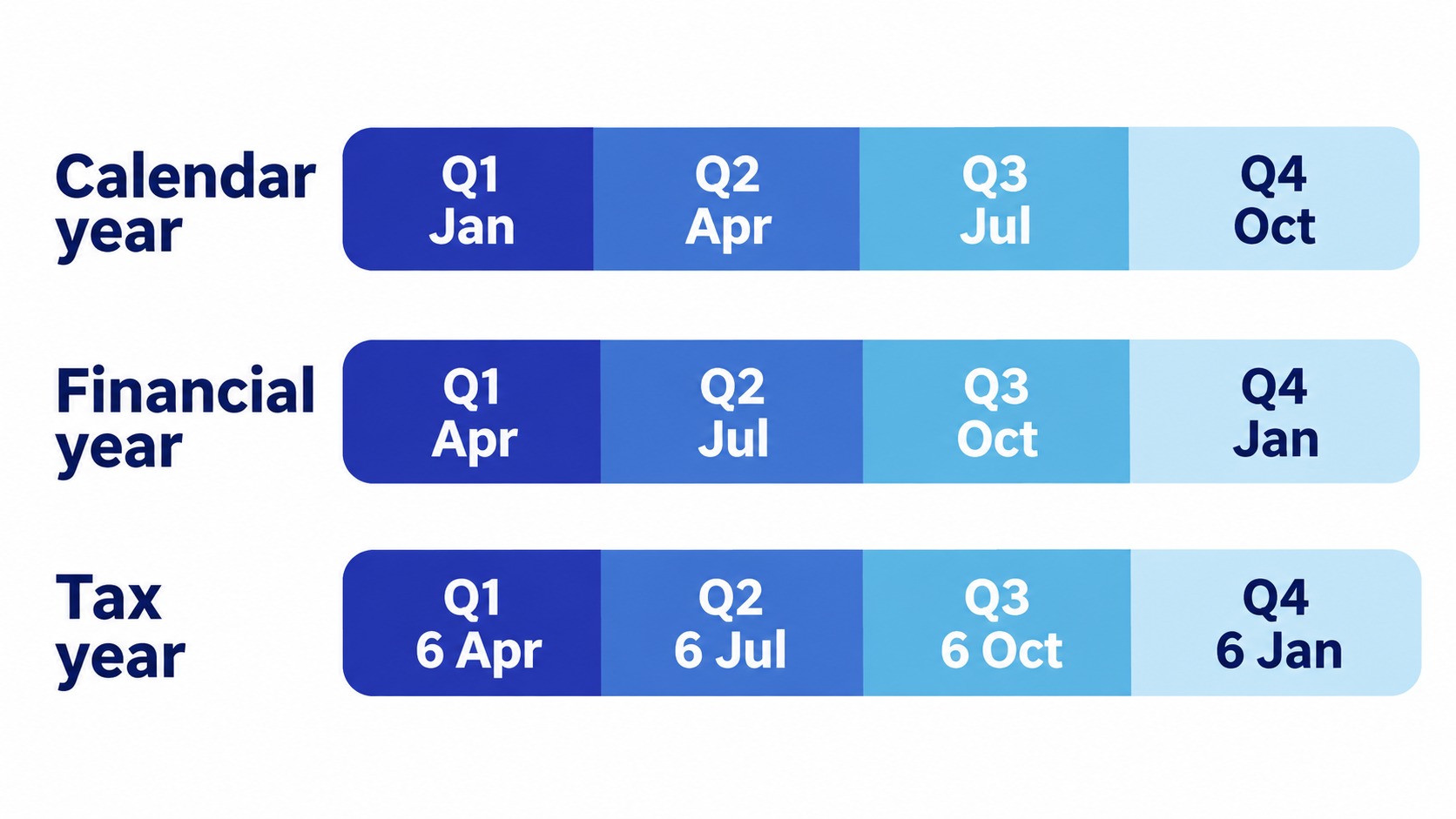
Here are the three main systems for 2026/27 in one table:
| Quarter | Calendar year 2026 | Financial year 2026–27 | Tax year 2026/27 |
|---|---|---|---|
| Q1 | 1 Jan – 31 Mar | 1 Apr – 30 Jun 2026 | 6 Apr – 5 Jul 2026 |
| Q2 | 1 Apr – 30 Jun | 1 Jul – 30 Sep 2026 | 6 Jul – 5 Oct 2026 |
| Q3 | 1 Jul – 30 Sep | 1 Oct – 31 Dec 2026 | 6 Oct 2026 – 5 Jan 2027 |
| Q4 | 1 Oct – 31 Dec | 1 Jan – 31 Mar 2027 | 6 Jan – 5 Apr 2027 |
This is why “Q1 2026” is ambiguous on its own. It could mean January to March or April to June. In contracts, reports and emails, state the actual start and end dates.
Financial Year vs Tax Year in the UK: Why There Are Three “Years”
- Calendar year (1 January): the default for most commercial reporting, markets and economic statistics.
- Financial year (1 April): UK financial year quarters run April to June, July to September, October to December and January to March. Government budgets use this year, and Corporation Tax rates are set for financial years running 1 April to 31 March.
- Tax year (6 April): used for Income Tax, National Insurance, PAYE and Self Assessment. The odd start date dates back to historic calendar changes, but it still governs personal tax.
For the annual personal tax dates that follow the tax year, see our guide to when Self Assessment tax returns are due.
How UK Businesses Use Quarterly Reporting Periods
UK businesses use quarterly reporting periods to track performance, keep budgets on course and plan cash flow. Tax is only part of it:
- Budgeting: four checkpoints a year make it easier to catch overspending early.
- Cash flow: putting money aside each quarter for VAT, PAYE or a Self Assessment payment avoids one large bill arriving unexpectedly.
- Reporting: lenders, investors and boards often ask for quarterly results, sometimes called fiscal quarter figures.
- Trends: comparing a quarter with the same quarter last year shows seasonal patterns that month-to-month figures can hide.
Label your reports clearly. A heading such as “Q1 (April–June 2026)” removes any doubt about which system you’re using.
How to Calculate Financial Quarters for Your Business
Standard tables of financial quarters in the UK won’t always fit your business. A limited company’s own year runs from its accounting reference date, which can fall in any month. You can work out its quarters in three steps:
- Find the first day of your accounting year. For a company, it’s the day after the previous year end.
- Count forward three full months to mark the end of Q1.
- Repeat three more times. Q4 should end on your year-end date.
- Q1: October – December 2026
- Q2: January – March 2027
- Q3: April – June 2027
- Q4: July – September 2027
Some retailers prefer 13-week quarters, often arranged as 4-4-5 weeks, so every quarter has the same number of trading weeks. That’s fine for internal reporting, but tax dates still follow HMRC’s rules. If your year end moves, your quarters move too. Our guide to the deadline for corporate tax returns explains how filing dates follow the accounting period.
VAT Quarter Dates 2026/27 and Stagger Groups
Most VAT-registered businesses submit a VAT return every three months. Both the return and the payment are usually due one calendar month and 7 days after the VAT quarter ends.
VAT quarters don’t all end in the same months. HMRC places businesses in one of three patterns, known as stagger groups. The table below uses the grouping described by accountancy firms such as Crunch. The due dates are worked out from HMRC’s one-month-and-7-days rule:
| Stagger | VAT quarters end | Return and payment usually due |
|---|---|---|
| 1 | March, June, September, December | 7 May, 7 August, 7 November, 7 February |
| 2 | April, July, October, January | 7 June, 7 September, 7 December, 7 March |
| 3 | May, August, November, February | 7 July, 7 October, 7 January, 7 April |
Your own VAT quarter dates appear in your VAT online account and on your registration certificate. Rely on those over any general table.
MTD for Income Tax Quarterly Updates
Sole traders and landlords within Making Tax Digital for Income Tax send quarterly updates through compatible software.
| Standard period | Calendar period | Deadline (2026/27) |
|---|---|---|
| 6 Apr – 5 Jul | 1 Apr – 30 Jun | 7 August 2026 |
| 6 Apr – 5 Oct | 1 Apr – 30 Sep | 7 November 2026 |
| 6 Apr – 5 Jan | 1 Apr – 31 Dec | 7 February 2027 |
| 6 Apr – 5 Apr | 1 Apr – 31 Mar | 7 May 2027 |
In your first MTD year, digital records start on 6 April 2026 for standard periods or 1 April 2026 for calendar periods, and the first update is due by 7 August 2026.
PAYE Quarterly Payments for Small Employers
Most employers pay PAYE every month. If your PAYE bill is usually less than £1,500 a month, you may be able to pay quarterly instead. Contact HMRC’s payment enquiry helpline to check that the arrangement suits you. The quarters follow the tax year:
| Quarter ends | Pay electronically by |
|---|---|
| 5 July 2026 | 22 July 2026 |
| 5 October 2026 | 22 October 2026 |
| 5 January 2027 | 22 January 2027 |
| 5 April 2027 | 22 April 2027 |
Your payroll reports (RTI submissions) still go to HMRC on or before each payday. Only the payment moves to a quarterly cycle.
Corporation Tax Instalments for Large Companies
Most small companies pay Corporation Tax in one amount, 9 months and 1 day after their accounting period ends. Larger companies, broadly those with taxable profits at an annual rate above £1.5 million but below £20 million, pay in quarterly instalments instead. For a company with a 1 January to 31 December 2026 year, GOV.UK gives the dates as 14 July 2026, 14 October 2026, 14 January 2027 and 14 April 2027.
The thresholds aren’t fixed for everyone:
- Associated companies: the £1.5 million (and £10 million) limits are divided by the number of associated companies, including the company itself.
- Short accounting periods: the limits work as annual rates, so a period shorter than 12 months is tested on that basis.
- First large period: a company with profits of no more than £10 million may avoid instalments if it wasn’t large in the previous 12 months.
- Small liabilities: if the total Corporation Tax for the period is under £10,000, the company pays in full by the normal date instead.
- Very large companies: profits over £20 million fall under separate, earlier payment rules.
Financial Quarters UK Calendar: UK Quarterly Tax Deadlines 2026/27
When people search for financial quarters UK deadlines, these are the dates they usually mean. This month-by-month view brings the UK quarterly tax deadlines above into one place. VAT dates assume stagger 1, so check your own.
| Date | What’s due |
|---|---|
| 22 July 2026 | Quarterly PAYE (quarter to 5 July) |
| 7 August 2026 | MTD update 1; VAT (quarter to 30 June) |
| 22 October 2026 | Quarterly PAYE (quarter to 5 October) |
| 7 November 2026 | MTD update 2; VAT (quarter to 30 September) |
| 22 January 2027 | Quarterly PAYE (quarter to 5 January) |
| 7 February 2027 | MTD update 3; VAT (quarter to 31 December) |
| 22 April 2027 | Quarterly PAYE (quarter to 5 April) |
| 7 May 2027 | MTD update 4; VAT (quarter to 31 March) |
For 2026/27, a missed MTD update date won’t bring a penalty point, but every update must be sent before your tax return. Annual deadlines sit on top of these dates; our tax return deadline guide covers 31 January.
Common Mistakes With Quarter Dates
Most date problems come from mixing two systems together.
| Mistake | What can happen | How to avoid it |
|---|---|---|
| Treating “Q1” as January everywhere | Wrong figures in a tax-year report | Write exact start and end dates |
| Assuming VAT quarters match the tax year | Late VAT return and penalty points | Check dates in your VAT account |
| Forgetting the 6 April start | Income placed in the wrong tax year | Treat 1–5 April separately |
| Sending only three months’ figures in an MTD update | Understated year-to-date totals | Remember updates are cumulative |
| Ignoring 2026/27 updates because there’s no penalty | Can’t submit the tax return on time | Keep sending each update |
- Personal tax, PAYE or MTD for Income Tax → tax-year quarters (from 6 April)
- VAT → the quarter dates HMRC gave you
- Corporation Tax rates → financial year (from 1 April)
- Company board reports → your own accounting year
- Market or economic news → calendar quarters
Financial Quarters UK FAQs
What are the Q1, Q2, Q3 and Q4 dates in the UK?
For the 1 April financial year: Q1 April–June, Q2 July–September, Q3 October–December and Q4 January–March. Calendar quarters start in January instead.
When is Q1 in the UK tax year?
6 April to 5 July. For 2026/27, that’s 6 April to 5 July 2026.
Is the UK financial year the same as the tax year?
No. The government financial year starts on 1 April, while the personal tax year starts on 6 April.
What is the difference between a financial quarter and a tax quarter?
A financial quarter divides a 1 April (or business) year into three-month blocks. A tax quarter follows the 6 April tax year and drives PAYE and MTD dates.
Does every UK company have the same financial quarters?
No. Each company’s quarters follow its own accounting year, which can end in any month.
What quarter is October in the UK?
Q3 of the 1 April financial year and Q4 of the calendar year. In the tax year, 1–5 October falls in Q2 and 6 October onwards in Q3.
When are VAT quarters due?
Usually one calendar month and 7 days after each VAT quarter ends, for both the return and the payment.
When are MTD quarterly updates due?
7 August, 7 November, 7 February and 7 May.
What happens if a quarterly tax update is submitted late?
For 2026/27, HMRC won’t give penalty points for a late MTD quarterly update, but you must still send it before filing your return. From 2027/28, each missed update can bring a penalty point. Late VAT returns already attract penalty points.
Can a business choose its own quarters?
For internal reporting, yes, based on its accounting year. HMRC deadlines still follow HMRC’s own rules.
Final Verdict: Financial Quarters UK Made Simple
The financial quarters UK businesses use depend on the year in question: calendar from January, financial from 1 April or tax from 6 April. Write out the exact dates instead of “Q1”. Note your VAT stagger and MTD deadlines, and put every quarterly date in one calendar. That way, nothing slips.
- Check your VAT quarter dates in your VAT online account.
- Read HMRC’s guide to using MTD for Income Tax for the first time if you’re a sole trader or landlord.
- Add the annual dates from our tax return deadline guide to your calendar.
- Deadlines checked against GOV.UK and HMRC guidance for 2026/27, including the MTD penalty relief.
- Covers calendar, financial, tax-year, company, VAT, PAYE and MTD quarters in one place.
- Last reviewed: November 2026.
- GOV.UK – Send quarterly updates (MTD for Income Tax)
- GOV.UK – Using Making Tax Digital for Income Tax for the first time
- GOV.UK – Penalties for Making Tax Digital for Income Tax
- GOV.UK – VAT Returns
- GOV.UK – Pay your VAT bill by Direct Debit
- HMRC – DMBM520055: PAYE payment frequencies and due dates
- GOV.UK – Corporation Tax rates
- GOV.UK – Pay Corporation Tax if you’re a large company
- Crunch – Understanding VAT quarters (stagger groups; secondary source)